

The addition of the Carolina Core’s Interstate 685 could have a profound impact on Sanford
By Richard Sullins
Additional reporting by Billy Liggett
Civilizations have come and gone over the course of human history. Some lasted only a few years, while others flourished for centuries and spread their influence over much of the known world. One of the greatest was Rome, whose conquests took place from the Middle East to the British Isles, and what made Roman society great was its system of roads.
Armies needed to be able to move quickly from one location to another, and that was often impeded by the muddy roads of the time that slowed troops and equipment down to a crawl. Roman Caesars developed methods of creating deep roadbeds of crushed stone, ensuring that water would drain through them instead of creating mud in the underlying soils. The armies of Rome could move quickly this way, and some of those roads still exist 2,000 years later.
The building of roads opened up areas like the Appalachian Mountains to development, and long-distance routes like the famous Route 66 made it possible for travelers and commerce to go coast-to-coast in just a few days. But it was the creation of the interstate highway system during the Eisenhower administration that brought the advent of economic development to cities and towns along those ribbons of highway.
Nearly 70 years after Eisenhower’s Federal Aid Highway Act of 1956, that development is now making its way to Sanford. And the future that is coming down a new section of interstate that will pass close to the city is one that will literally put Sanford on the map.

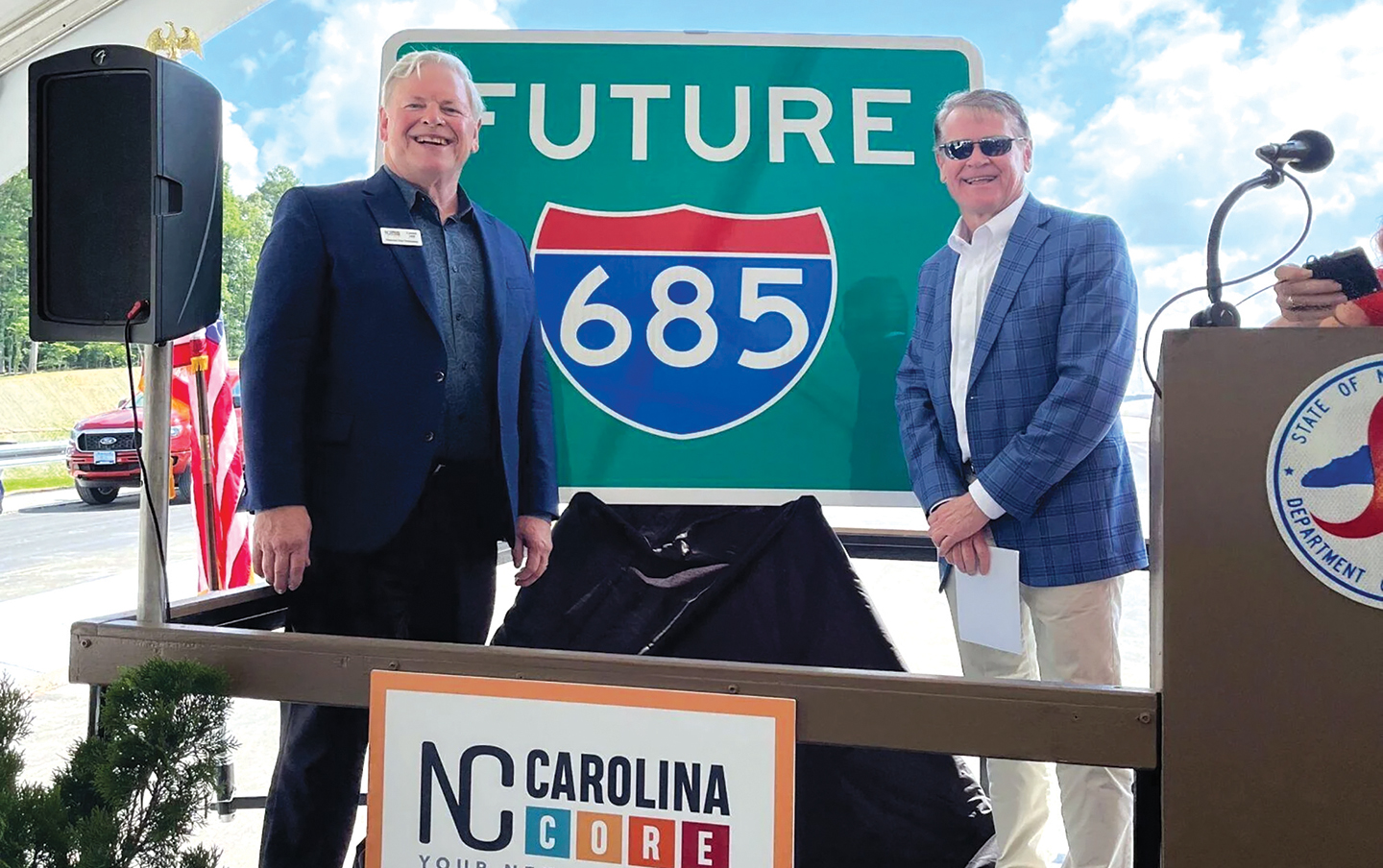
You may have already seen them — those signs that have gone up along the U.S. 421 by-pass along the northern and eastern sides of Sanford, proclaiming that those stretches of roadway now have a new designation: “Future Interstate 685.”
At an unveiling event on May 20 in Randolph County, regional transportation, economic development, elected officials and business leaders gathered along the highway as the first of the new signs was given a public unveiling. It was an event more than six years in the making, and many in the crowd had been along for the ride during the entire trip.
The placement of these signs was really a symbolic act, because nothing changes in the short term. But over the next few years, as sections of existing U.S. 421 get a facelift and new construction takes place near the southern end of the corridor, North Carolina will be able to open one of its newest interstate highways that will deliver on one of the top items on the wish lists of almost every economic development agency in the state: a direct linkup between I-85 and I-95.
When Congress passed the Infrastructure Investment and Jobs Act in 2021, the bill contained language inserted at the urging of U.S. Senators Richard Burr and Thom Tillis to begin the process of redesignating about 120 miles of highway between Winston-Salem and Fayetteville as Interstate 685.
When completed, this 120-mile stretch of what is now U.S. 421 from west of Winston-Salem to Dunn will bear the designation as one of the state’s newest and most important interstates, I-685. The highway will connect the cities of Greensboro, High Point, Siler City, Sanford, Lillington, and Fayetteville, and most importantly, will provide the vital connection between I-85 and I-95.
Language contained within the Infrastructure Act designates the existing four-lane sections of highway between Greensboro and Sanford as a “high priority corridor,” meaning that it will rank higher on the listing of federal funding priorities as those dollars get distributed between now and 2026.
That will be especially important for the new construction work that will extend the four-lane highway from just north of Broadway to where it will terminate in Dunn along I-95. Three alternate routes for that stretch are now being reviewed for this new segment that will stretch from Sanford to I-95. All three of these alternate routes are projected to go through Harnett County.

Heart of the Core
Legend has it Sanford, North Carolina was once considered as a location for North Carolina’s zoo in the 1960s. The area had plenty of untouched wooded land and was easily accessible from U.S. 1. But U.S. 1 was quickly losing relevance with the addition of Interstate 95, which began in the 1950s and would eventually become the main north-south corridor through the eastern part of the state upon its completion in the 70s.
So in 1968, the N.C. Zoological Garden Study Commission eventually landed on Asheboro, which today is just a short distance from Interstate 74 (eventually built in the 90s). The zoo attracts over a million visitors annually and is becoming one of the country’s largest zoos thanks to upcoming additions.
Economic developers like Jimmy Randolph of the Sanford Area Growth Alliance know the importance of not just location, but being in a location that is easily accessible. That’s why he sees enormous potential for big economic impact from the new interstate.
Randolph and other economic development and business leaders have been pushing to get this section of U.S. 421 redesignated as an interstate for nearly a decade. They believe that adding another artery along this booming corridor in the heart of North Carolina will help to further increase safety for the passengers and cargo that will travel on what will become one of the state’s busiest roads.

But I-685 will do much more than just connect Sanford to other large population centers. It will improve access to Fort Liberty and allow America’s military to move more quickly if the need to defend the homeland arises. It will further add to the region’s existing transportation network and create even faster ways to evacuate the public when needed during natural disasters.
For Sanford, being situated along an interstate route can enhance accessibility and attract businesses, tourists and investment. The designation that the I-685 highway will bring signifies that Sanford and Lee County are connected to broader markets and now have access to a steady flow of traffic, which can stimulate commercial activity and job creation.
“The portion of the future I-685 from Greensboro to Sanford is already practically interstate quality, with just a few signalized intersections which would require modification in order to fully meet interstate standards,” Randolph said. “Based on this current reality, Sanford and Lee County are already realizing many of the practical benefits afforded by a safe, high-speed, limited access highway corridor connecting our community to the other vibrant economies of the Carolina Core to our west. These benefits will only be amplified as Toyota North America and WolfSpeed complete construction of their facilities in Liberty and Siler City and enter active production mode.”
Randolph said it is difficult to adequately quantify the potential economic ripple effects just from these two companies (and their combined $19 billion investment) alone, but he’s certain Sanford and Lee County are well-positioned to take maximum advantage of those effects.
“Beyond the practical advantages of interstate highway connectivity between regional economies, the I-685 shield offers tangible benefits from a marketing perspective. For any business that relies on highway-based logistics to transport raw materials, parts and finished goods, the US interstate highway system is recognized as the optimal route for both safety and efficiency,” he said.
The presence of an interstate highway can bolster local businesses by increasing visibility and accessibility to a broader customer base. Retail establishments, restaurants and service providers located near interstate exits often benefit from passing travelers who stop for goods and services, and that leads to increased sales and tax revenue.
Interstate highways can also attract industrial and commercial development to the area. Businesses looking to distribute goods regionally or nationally seek locations with efficient transportation infrastructure, including proximity to interstate highways. Local governments and economic development agencies often leverage the interstate designation as a selling point to attract companies that rely on transportation networks for their operations. This can lead to the establishment of distribution centers, logistics hubs, and manufacturing facilities that bring jobs and economic investment to the community.
Randolph said many of the information requests SAGA receives from companies seeking to site a manufacturing facility in North America cite proximity to an interstate as a primary requirement. Already, the path will go through or near four “megasites” — the future Vinfast facility in Moncure, the Toyota car battery plant in Randolph County, the plant Wolfspeed is building near Siler City and the Piedmont Triad International Airport aerospace megasite near Winston-Salem.
Improved highway access was part of the investment package that attracted Vinfast.
“Even though experience tells us that U.S. 1 and U.S. 421 are essentially interstate-quality, the lack of an interstate shield on the map automatically eliminates us from consideration for some projects,” he said. “The future I-685 designation now allows us to overcome that hurdle in some instances.”
The designation of a road as an interstate highway can also enhance tourism and hospitality sectors within a local economy like Sanford’s. Tourist attractions, hotels, and recreational facilities located near interstate exits can draw visitors traveling for business or pleasure. The convenience of interstate access can encourages tourists to explore nearby attractions and spend money here, supporting restaurants, shops, and local attractions.
Paying for it
In North Carolina, funding for interstate highways primarily comes from a combination of federal and state sources. Since the 1950s, the state legislature has seen its network of major highways as being crucial components of the state’s infrastructure network, and they have created a system that works in tandem with federal funding to keep the interstate system of roads safe, efficient and capable of supporting the needs of the Tar Heel State well into the future.
At the federal level, funding comes mostly through the Federal Highway Trust Fund, which is supported by federal fuel taxes, excise taxes on heavy trucks, and other highway-related taxes and fees. The federal tax on gasoline has been set at 18.4 cents per gallon since 1993. These funds are distributed to states based on formulas that consider factors like highway mileage, population, and traffic volume and because of its size and high traffic, North Carolina receives a significant portion of its interstate funding from the federal gas tax.
There is also funding for portions of I-685’s new construction in the Infrastructure Investment and Jobs Act.
The State of North Carolina also contributes funding to support interstate highways through various mechanisms. One primary source is the North Carolina Department of Transportation budget, which includes revenues from state fuel taxes (40.5 cents per gallon in 2024), vehicle registration fees and other transportation-related revenues. These funds are used not only for interstate maintenance and repairs, but also for construction projects aimed at expanding and enhancing the interstate network.
The timeline
The conversion of U.S. 421 to Interstate 685 is a lot more than just switching out identification signs. Bringing a highway up to interstate standards is really a detailed and meticulous process to ensure that the end product meets the criteria for safety, efficiency, and functionality.
This level of transformation takes a lot of planning, engineering and construction work to make the highway comply with federal regulations set forth by the Federal Highway Administration.
One of the primary considerations is that interstate highways must have controlled access, meaning limited entry and exit points with designated ramps and interchanges. Portions of the existing U.S. 421 may require the redesign of some intersections, adding acceleration and deceleration lanes, and eliminating direct driveway access to ensure uninterrupted flow and safety at higher speeds that are seen on interstates.
The quality of the pavement is crucial. Interstates demand durable and smooth pavements capable of withstanding heavy traffic volumes and varying weather conditions. Upgrading existing pavements often involves resurfacing or reconstructing sections to meet specific thickness and smoothness requirements mandated by interstate standards. This ensures long-term sustainability and reduces maintenance costs over the highway’s lifespan.
Clear and consistent signage is essential for guiding drivers safely along the highway, especially at complex interchanges and exits. Upgrading signage involves installing larger, more visible signs with standardized fonts and symbols that comply with FHWA guidelines.
Interstate highways must meet stringent safety standards, including requirements for crash barriers, guardrails, and median dividers to minimize the risk of collisions and protect motorists. Incorporating advanced traffic management systems is increasingly important for modern interstates. These systems include intelligent transportation technologies such as traffic cameras, variable message signs and electronic tolling equipment.
The path from Greensboro to Sanford will require a lot of work, but that stretch is already prime for relatively easy upgrades. It’s the stretch from Sanford to Harnett County that will take the most work and time. U.S. 421 is currently a two-lane highway between Sanford and Lillington, and should the final path go through Dunn, considerable work will need to be done. NC DOT is also looking at options through southwestern Harnett County that would end closer to Fayetteville.
No reports have been released dictating a timeline for that portion of the project. While the portion of interstate near the Toyota plant in Liberty is already nearing completion, anything east or southeast of Sanford is likely several years away.
In 1968 I took a job with Alamance County just as _I-85 had been completed through Burlington. In 1975 I got a job as transportation planner with the City of Salisbury as it was adjusting to the I-85 connection into Charlotte was providing for that integral link with the Piedmont Crescent from Raleigh to Atlanta. In 1978 I arrived in Nash County as the Planning Director when the final stages of I-95 were finishing. Your article correctly state the long term implication of these massive infrastructure investments in high speed interstate thoroughfares. I’ve seen those changes and I’ve also seen repeated errors by state and local governments in how they responded or neglected the opportunities offered. The decisions made right now in preparation for what is to come will determine the real value we will realize.
Robert Bridwell, AICP
The Lake, inlets and creeks at Carolina Trace were greatly harmed due to severe mud runoff when the improvements to 421 were made in recent years. I hope that avoiding this type of damage will be taken into consideration and avoided by the project managers, engineers and anyone else heading the construction prior to beginning the project.