

On the heels of unprecedented success, and on the cusp of a nearly $100M expansion, Grace Christian School is under fire from parents, faculty for its ‘changing culture’ and for doubling tuition while leading the state in N.C. Opportunity Scholarship funding
TAKEAWAYS
- Grace Christian School has led all 600-plus North Carolina private schools in state-funded N.C. Opportunity Scholarships each of the last three years, with recipients receiving more than $10M.
- Parents say Grace has more than doubled its tuition in the last two years, from $8K to more than $18K per student for many.
- Several parents have publicly complained about Grace denying their children enrollment because of ‘administrative prerogative.’
- Several former faculty have publicly accused Grace of firing them or not picking up their contracts after their complaints or concerns addressed to Grace administration.
- Grace Christian School has announced plans for a nearly $100M expansion project that will include new buildings and athletics facilities to keep up with their fast-growing enrollment.
When the oak trees and kudzu nestled among the tall pines across from her home are bare during the winter months, Ramona Willett can see Grace Chapel Church from her front doorstep. The church has been a part of her family for as long as she can remember, and when a group of parents decided to launch Sanford’s first private school dedicated to Christian education in the early 1970s, her father was among the leaders who made it happen.
“My first Sunday in a church was at Grace. I was in a crib, and [my husband] Gary was in one nearby,” says Willett. “Both of our families have connections. Both of our families have deep, deep roots with this church.”

Despite the history and the proximity, the Willetts’ relationship with Grace has soured in recent years.
A former math teacher at Grace Christian School, Ramona Willett was let go at the end of the 2017-18 school year, just weeks, she says, after expressing her concerns to the administration about the school’s overall direction. And this year, the school informed her granddaughter, Briella — a student at Grace from kindergarten through the seventh grade (and who attended the Child Development Center prior to kindergarten) — that she was not eligible for re-enrollment next fall due to “administrative prerogative.”
On May 15, Willett took to social media to express her heartbreak and disappointment in the church and school she had supported for many years. Her Facebook post detailing her granddaughter’s dismissal garnered hundreds of likes, comments and shares and led others to follow suit with similar stories of what they deem “unfair” dismissals — often stemming from disagreements with administration — and the overall school culture under the current administration.
Since then, more than a dozen former faculty and staff members and parents of current or former students of Grace Christian School have come forward to The Rant to express their experiences and concerns over skyrocketing tuition costs (despite Grace leading North Carolina in public voucher funding for the past three years), spending that focuses more on athletic success and “branding” than their children’s education, and their negative interactions with school and church leadership.
Some quoted in this story have asked for anonymity out of fear of retribution against children still enrolled at Grace or family members still involved in the church. Others like Ricky and Tonya Dew — whose son Gaige was also dismissed for “administrative prerogative” this year, because they say he “socially didn’t fit in” — say going public has already severed relationships with those still involved at Grace but has also led to support from friends, family and strangers who’ve had similar experiences.
“This isn’t about taking down the school,” Ricky Dew wrote in a May 21 Facebook post. “It’s about making sure other families don’t go through the pain we’ve experienced. It’s about letting people know our side of the story and holding those involved accountable.”
OPPORTUNITY KNOCKS
When North Carolina Republican lawmakers expanded the then decade-old N.C. Opportunity Scholarship program in 2023 — removing income caps for a program initially designed to make private school more affordable for low-income families and parents of students in under-performing public schools — it opened the floodgates on the number of applications received that year and ever since.
Private schools have benefited immensely from the program — more than 80,000 North Carolina students received vouchers for the 2024-2025 school year, and at last count (in April), more than 40,000 additional first-time applications were turned in to attend school this fall.
In June, the state reported it saved $10 million because of the program, as the scholarships — which range between $3,500 and $7,700 depending on family income — are far cheaper than the annual cost to educate a child in public schools ($12,500 … and North Carolina ranked 48th in the nation in per-pupil spending).
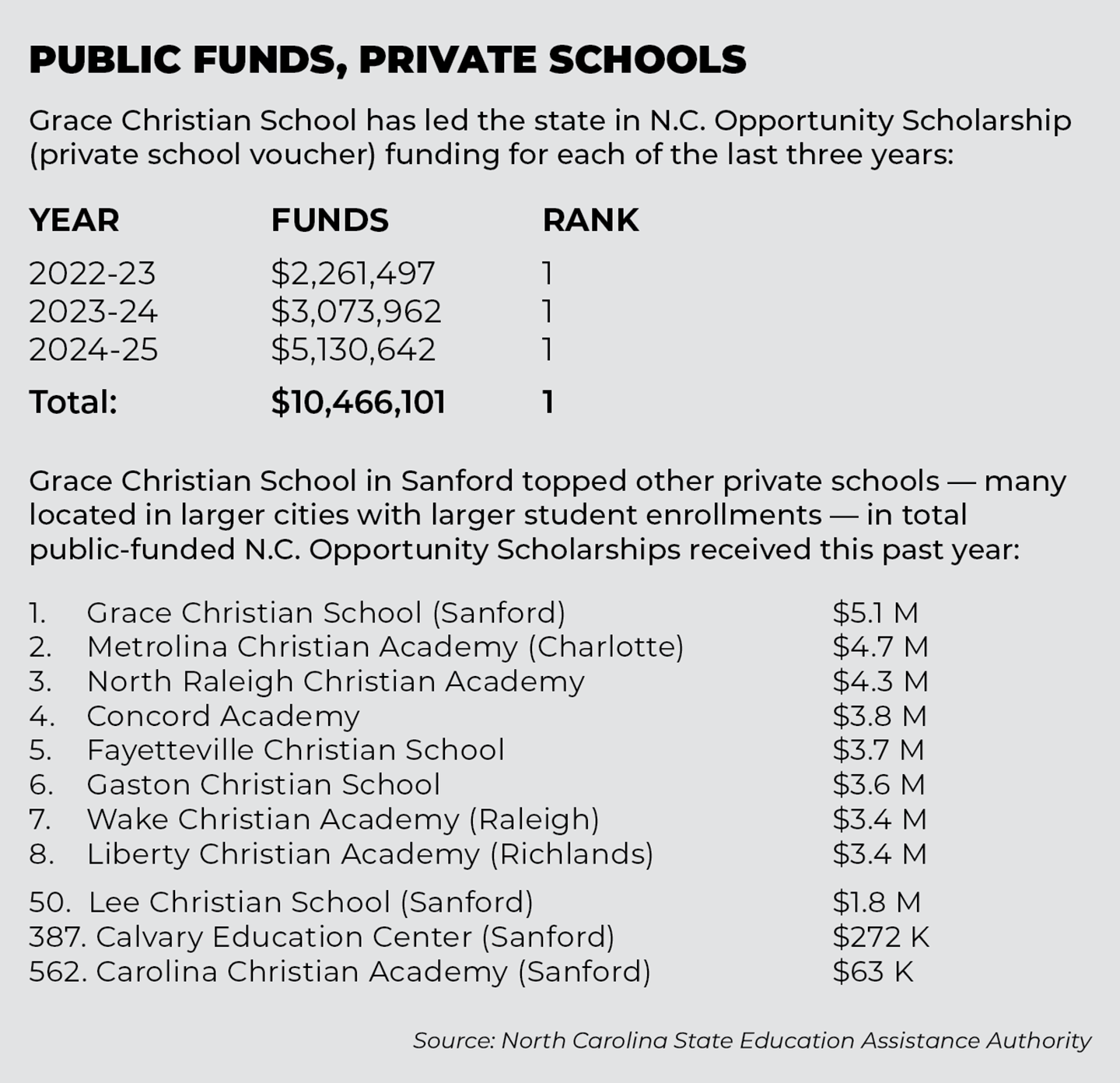
No school in the state has benefited more from the North Carolina Opportunity Scholarship program than Grace Christian School. According to data shared by the North Carolina State Education Assistance Authority — which oversees the scholarship — Grace Christian has led all 600-plus private schools in the state in public funding each of the last three years.
Grace Christian students received $5,130,642 in tuition assistance during the 2024-2025 school year. That was a $2 million jump from the $3.07 million it received the prior school year, and nearly $3 million more than the $2.26 million it received in the 2022-2023 school year. In total, Grace Christian students have received nearly $10.5 million in state tuition assistance for the last three academic years. Concord Academy and Trinity Christian School in Fayetteville rank second and third at around $7.6 million during that time.
Despite the huge bump in state funding, Grace Christian has more than doubled its tuition in the past two years — a point of contention for every parent and former faculty member who spoke to The Rant.
A June 13 email from The Rant sent to Grace Christian School and Grace Chapel Church leadership asking for an interview to discuss the Opportunity Scholarship and tuition hike was unanswered as of the publication of this story.
According to “John” (his name withheld because of friends and family employed or enrolled at Grace), tuition for his high school student for the 2023-24 school year was just under $9,000. In 2024-25, that tuition jumped to $17,900, and heading into this school year, his family has been asked to pay more than $18,300 for tuition and fees (for just one student).
“I think everybody was in a state of panic when we saw this, saying, ‘What the heck is going on here?’” John says. “There’s no way families in Sanford can afford $18,000 tuition a year. But then they push this Opportunity Scholarship like you’re getting a deal. And they also offer Grace Financial Aid, with a $40 application fee. Both of these require a family to provide their tax returns.”
After receiving between $4,000 and $5,000 for the Opportunity Scholarship and money from Grace Financial Aid, John says his family ended up paying just over $8,000 out-of-pocket for their child’s tuition for the past school year.
“Grace requires you to apply for this Opportunity Scholarship, regardless of how much you make and regardless of whether you’re even seeking it,” he says. “And [because of the tuition hike], our actual payment this past year was about the same as we were paying during previous years with no financial aid.”
Even students who receive significant discounts (up to 85 percent) because a family member is employed by Grace are required to apply for the scholarship, which goes directly to the school rather than the family. “Without a doubt, Grace Christian School is taking advantage of this,” adds John.
“If you make $150,000 a year, I have no idea why the government would want to subsidize your child’s private education. That just seems silly to me.”
— Grace Christian School Parent —
The Opportunity Scholarship and tuition hike come at an already financially lucrative time for Grace Chapel Church (the school falls under the authority and incorporation of the church, which has supported it as a community ministry by providing the facilities, utilities and financial support). According to Candid (free login needed), a nonprofit that provides comprehensive data on other nonprofit organizations across the globe, Grace Chapel earned $20.2 million in total revenue (donations, tuition payments and other funds) in 2023, more than triple the amount it brought in just six years earlier in 2017.
Grace Christian School, meanwhile, is enjoying across-the-board success in enrollment, finances and athletics never before seen in its 50-plus years. The number of students in K-12 has nearly tripled since the pandemic (when Grace was one of the few schools in the region to continue with in-person classes and a no-mask policy). And the school has spent big on renovations for new and existing athletics facilities, helping boost multiple sports programs that have won several state titles and even gained national exposure in recent years.
Grace Christian is by no means the only private school in the state that has boosted tuition since the expansion of the Opportunity Scholarship program in the last three years. According to a recent report by Public Schools First NC, national studies tracking voucher expansions in states like Iowa and Arizona found that several private schools in those states also raised tuition and pressured families to apply for vouchers.
The group’s examination of North Carolina found similar patterns. It reported: “We found sharp tuition rate increases in the first year of universal voucher availability, with many schools raising rates to match the voucher amounts. We also found evidence of schools taking advantage of the voucher program by giving admissions preference to families who applied for vouchers or requiring families to apply for a voucher as part of the school’s admissions process.”
The group’s report specifically names Grace Christian School and quotes its admissions website, which requires all students to apply for the scholarship prior to enrollment.
“The way the proponents of both the voucher program and private schools see it, these are private contracts between parents and the school. If parents don’t like the arrangement [increased tuition], they don’t have to send their kids there.”
— Jane Wettach, Duke University School of Law —
No rules are published on the North Carolina State Education Assistance Authority’s website stating that a school can or cannot require families to apply (a media request for more information on the rules was sent to the organization on June 16). But according to Jane Wettach — a clinical professor and expert in education law at Duke University School of Law who has studied private K-12 education in North Carolina for several years — the optics of a school requiring parents to apply for state funds, doubling tuition and spending big on athletics facilities certainly aren’t great.
“It was contemplated that this would happen,” says Wettach, who wrote an early study on the state’s school voucher program in 2014, a year after the Opportunity Scholarship was launched. “There’s nothing in the law that would prevent it. And it’s a predictable result of the way the program was designed. There was never a hearing [in the General Assembly] about whether North Carolina should have vouchers. There was never a public vote. Most all of this has been built into budget bills and has never had an up-or-down vote.
“The way the proponents of both the voucher program and private schools see it, these are private contracts between parents and the school. If parents don’t like the arrangement [increased tuition], they don’t have to send their kids there.”
Wettach says the Opportunity Scholarship is less about “school choice” and more about state money being used to make private schools bigger and better. Recent reports on the success of the voucher program back up her statement.
According to a June 5 article by WUNC, the biggest change to the scholarship last year wasn’t lifting the income cap; it was allowing families with students who already attended private schools without a voucher to become eligible to apply for it for the first time. WUNC reported that about 90 percent of Opportunity Scholarship recipients this year already attended or had previously attended a private school when they applied for the voucher. The News & Observer in Raleigh reported that 42 percent of the applications for the Opportunity Scholarship in 2024 came from families who were too wealthy to apply in previous years.
Critics say instead of helping low-income families overall, the program is now providing a boost to disposable income for families that were previously paying tuition.
“If you make $150,000 a year, I have no idea why the government would want to subsidize your child’s private education,” John says. “That just seems silly to me.”
FROM THE ASHES
To understand and appreciate the current success of Grace Chapel Church and Grace Christian School and the complaints that have been levied against them, Ramona Willett says you have to understand the church’s past. Specifically, its recent rocky financial past, which goes back more than a decade to the days of Rudy Holland, former pastor at Grace Chapel Church. She recalls penning a letter to the church leadership in 2013 where she expressed worry over the church’s financial situation — it was, she alleges, nearly $10 million in debt at the time, wasn’t paying its mortgage and hadn’t paid social security taxes for her and other employees for multiple years (among other serious financial issues).
On Jan. 30, 2014, Grace Chapel Church and former operations director (and former county commissioner) Bill Carver filed a report with the Lee County Sheriff’s Office claiming Holland embezzled $200,000 from the church. Holland, who had stepped down as pastor two months prior (shortly after Willett’s letter), had been the target of a previous embezzlement investigation in the 1980s (doubling that amount) at a church he founded in Virginia.

“Considerable damage had been done,” Willett says.
The following year, three former Grace Chapel Church employees were arrested on separate felony embezzlement charges, going back as far as 2006.
Two employees were charged with taking more than $43,000 and $133,000 respectively — the latter over a six-year period — and a third employee was charged with withdrawals topping $177,000 in 2014.
The first two pleaded guilty, were sentenced to felony probation, and were ordered to pay back the money they took. According to court records, the third employee spent 565 days in jail before entering an Alford plea in 2017 and has only paid back $360 of the $170,000.
Holland was never charged and today is a ministry representative for the National Center for Life and Liberty, a nonprofit legal ministry based in Florida.
These incidents provide context for the financial turnaround Grace Chapel Church has seen over the last decade. In a two-part sermon series in 2023 titled “Money Matters,” Pastor Joel Murr — whose brother Tim also stepped down in 2013 following the embezzlement claims levied against Holland — reflected on the church’s troubles 10 years earlier, saying, “I was here when we weren’t a financially healthy church. I remember the mistakes that we made, things that caused great harm and hurt the body of Christ and hurt the heart of God. I’m so thankful today that we’re a financially healthy church. Not every church can say that.”
Willett was still teaching math when Stuart Shumway joined Grace Christian as head of school in 2017. The school was going through an accreditation process at the time, and she recalls requesting a meeting with Joel Murr to express concerns over the process. Murr suggested she meet with Shumway to discuss his handling of certain issues of concern. When Willett was called in to discuss her contract renewal, Shumway told her he wanted “to take the math department in a different direction” and told her they would not be extending her contract at the end of the academic year.
“He said they ‘found a better fit,’” Willett recalls. “I was hurt, but I’ll never forget those words. I looked at him and said, ‘No sir, you’re telling me this, because I confronted this school with issues … and I screwed myself out of a job.’”
Eight years later, in January, her middle school grandchild was informed by Brown and the school that she would not be eligible to re-enroll this fall, due to “administrative prerogative.”
“It breaks my heart,” Willett says. “It breaks my heart that they’ve done this to our granddaughter, and it breaks my heart that we’re not alone. What hurts is the light this sheds on Christians.
“My God is good. He is grieved over this, too.”

ADMINISTRATIVE PREROGATIVE
The cell phone photo posted to Facebook by Teresa Dew Kelly (a member of the Broadway Town Board) on May 16 shows her 13-year-old grandson sunk into his family’s leather couch, wearing a black Grace Christian polo shirt and a look of devastation on his face. Her caption: “This was the day they told us that Gaige was not welcome back at Grace next year because he didn’t socially fit in. [His parents] tried to tell him it wasn’t his fault, but it broke his heart.”
Kelly’s post was met with 272 comments and nearly 200 shares from family, friends and strangers — a few sharing their similar experiences. A week later, Gaige’s parents Ricky and Tonya Dew reshared the image and went into great public detail on the events that led to their son’s ultimate dismissal from Grace Christian School — the school he’d attended for several years and the school his older brother Wyatt had just graduated from.
“This isn’t an attempt to trash Grace Christian School or the wonderful faculty members who have been involved or not involved in this situation,” Ricky Dew prefaced in his own 1,650-word post. “We had wonderful experiences for about 3.5 years, until we found ourselves on the other side of things — no answers, no support and a child who had no idea what went wrong. It’s not fair to him or us.”
The more succinct version of the Dews’ story begins at the end of his sixth-grade year, when his parents say a few of his classmates picked on him. Ricky and Tonya say they contacted the administration “several times” asking for help. They contacted Upper School Principal Kevyn Brown, who told them to talk directly to the teachers and encourage their son not to take action “unless provoked.” Not long after, they say Gaige hit a student who was picking on him, and Gaige was put into in-school suspension. Their son was later accused of mouthing a bad word to another student and was given a warning. In another instance, he was accused of using a racial slur (it was later determined by administration the word was not said, and no action was taken).
Last January, the Dews got an email from Grace Christian School informing them Gaige would not be able to enroll in the fall. The photo originally shared by Gaige’s grandmother was taken by Tonya, because she wanted the administration — specifically Shumway, Brown and Chief Financial Officer Jonathan Bullard — to see the pain they caused her son and her family.
“When asked why, Mr. Brown wouldn’t give us an answer. Mr. Shumway wouldn’t give us an answer. They wouldn’t give us an in-person meeting,” Tonya Dew says. “I was told we could do a phone conference, and it felt like I was talking to a pre-recorded message, because every time I asked ‘why,’ the answer was ‘administrative prerogative.’ They probably used that phrase 20 times.”
“Administrative Prerogative” are the first words on Page 1 (right after the cover page) of the 2025-2026 Grace Christian School Parent & Student Handbook. Its definition even precedes the Table of Contents. Under the title, the handbook reads: “The administration of Grace Christian School reserves the right to exercise its administrative prerogative in responding to any situation. Responses may include, but are not limited to; parent conference, suspension and/or expulsion, drug testing and required counseling.”
“The news absolutely devastated our son to hear that you’re not welcome back. That you do not socially fit in.”
— Ricky Dew —
Ricky Dew says the generic definition — and using that term as the sole reason for a child’s dismissal from the school — acts as a shield for the administration to make these types of decisions with little or no accountability.
“The news absolutely devastated our son to hear that you’re not welcome back. That you do not socially fit in,” Ricky Dew says. “If anything at all positive has come from this experience, it’s that we’ve received a lot of support from people coming out of the woodwork who tell us they’re glad we’re standing up. If we stay quiet, the chances of [other parents] eventually going through this will be higher. That’s my biggest fear … that this will keep happening to kids who don’t deserve being treated this way.”
LaRue Wilson’s August 2024 Facebook post detailing her high school daughter’s denied re-enrollment at Grace Christian School topped 2,000 words. She followed up with another lengthy post in June of this year after seeing other parents share experiences similar to hers.
Last summer, her daughter Kaleigh (a rising junior at the time who’d attended Grace since second grade) posted a video to social media of her and a friend dancing during a family trip to Myrtle Beach while holding red Solo cups. Nothing in the video — aside from the cup being plastic and red — suggested alcohol was involved, Wilson says, but shortly after it was posted, she was contacted by Grace and told Kaleigh would face a suspension (both in class and in volleyball). She says Child Protective Services was also notified and visited the Wilson home.
Wilson says she fought back instead of accepting the punishment. She accused the administration of not following its own policies regarding social media use and grievance resolution. She demanded what she called “due process,” but because her husband worked at Grace at the time, she says all communication from Shumway and Brown was directed at him, avoiding her.
“I pushed back,” she says. “For some reason, they refused to offer my daughter any defense, and I wasn’t just going to sit back and let it happen.”
On Aug. 7, 2023, just weeks before the start of Kaleigh’s junior year, Grace Christian informed the Wilsons their daughter would not be allowed to enroll for the upcoming year. And because of transfer rules in athletics, Kaleigh — an all-district and all-state athlete in volleyball — was unable to play for crosstown private school Lee Christian Academy for 90 days.
The news was devastating.
“I kept telling Kaleigh this is not how Christians act toward others,” Wilson wrote in 2024. “[Brown] did not even take the time to find out what Kaleigh had to say or [to know] the truth. I honestly do not think he wanted to know the truth.”
The dismissal was not the end of the Wilsons’ problems with Grace. Before Kaleigh could transfer to another private or public school, her parents had to pay $4,500 to retrieve her school transcripts. When they inquired about their younger child’s disability grant — paid for through the state to the school — and the fact that it well exceeded his tuition (thanks to the family’s 75-percent employee discount tuition), Wilson says Grace refused to refund the difference, which she says totaled just under $6,000.
Wilson says she and her husband, who quit his job at Grace after their daughter was dismissed, are planning to file a lawsuit against the school and church to rectify the funds and potentially for other damages.
When Briella Willett’s mother was told via a phone call on Jan. 24 that her daughter would not be able to re-enroll the following fall, Briella was given the option to transfer, but she chose to remain at Grace through the end of the school year. Briella attended classes with her friends knowing she wouldn’t be back the following school year. She cheered on the middle school squad knowing these would be her final sporting events at Grace.
“She would say, ‘I thought I would graduate from Grace. I can’t believe I’m having to choose another school,’” Ramona says.
Willett says her granddaughter wasn’t a “misfit.” She says they asked administration to give her answers to what she did wrong, saying they needed to know so the family could deal with the issue and work with her in “whatever area of life caused this.” The answer Willett kept getting from Grace Christian School: “Administrative prerogative.”
“She isn’t a perfect kid. Nobody’s perfect unless you’re Jesus,” Willett says. “But she’s a good girl. She’s a great girl. I know there are two sides to every story, but all I’m asking is for Grace to give me their side.”
Callie Taylor shared her experience with Grace Christian School’s admissions process on social media back in 2022 after trying to enroll her two boys, both elementary school-aged. She deleted the post because of the several negative comments she says she received from Grace parents and others associated with the school. When she saw the testimonies from other parents three years later, she says she felt emboldened to speak out again.
Taylor — who has two sons; the oldest with high-functioning special needs — says during her campus tour, Shumway pushed the idea of her family receiving an ESA+ scholarship, a state-funded program that provides assistance to students with disabilities. At the time, she says, Shumway “was all about” having a student with ESA+ funding — “I could tell he was dismissive with talking to me,” she says, “and wanted my husband to be at the meeting. But that wasn’t possible, because he was deployed. So I didn’t think it was a good fit [at the time].”
In 2024, she revisited the enrollment process after her husband returned. She says Grace would not offer her family a tour or an in-person meeting, but did ask to assess her two sons separately.
“I felt like we never fit in. I just wanted to have a Christian home for them — you would think a Christian school would be the first place to accept him.”
— Callie Taylor —
“All they wanted was my oldest son’s IEP [a legal document that outlines a child’s disability and his or her educational needs], which had not been updated in two years,” Taylor says. “It was not accurate to his growth over that time. I even had his current teacher write a letter saying the IEP was inaccurate.”
She says Grace assessed both children, and after several weeks of silence (despite “thousands of emails” Taylor says she sent seeking an answer), Grace informed her they would accept her youngest son, but not her son with special needs. Taylor asked for in-person meetings to “plead her case,” but she says Grace administration refused. The decision — in addition to the “cold” approach and refusal to follow up in person — were “heartbreaking,” she says.
“I felt like we never fit in,” Taylor says, wiping away tears. “I just wanted to have a Christian home for them — you would think a Christian school would be the first place to accept him. He’s not a problem child, and I’m just as active a parent as anybody. I told them this, and they wouldn’t even talk to us. They would rather split two brothers up than take on [a perceived challenge].”
“That’s not the vibe I want my kids to be around,” she adds. “I expected open arms, excitement and the feeling that they wanted to love my children. But it was the complete opposite.”
Several other parents of current and former students reached out to The Rant with similar experiences with the Grace administration. “Michelle” (real name withheld) says that after declining a job offer with Grace and after a later disagreement (the details would threaten her anonymity), her child was denied enrollment based on “administrative prerogative.” Her letter read: “A continued enrollment relationship between your family and our school is not in either of our best interests.”
The common thread in the parents’ testimonies is this: Children who don’t “fit the mold” and parents who don’t “fall in line” with the school’s leadership are not welcome.
As of the deadline for this story, a June 13 email from The Rant to Shumway and Joel Murr asking for an interview or responses to recent public complaints from parents on social media was unanswered by both men.
FACULTY FRICTION
In 2020, Grace Chapel Church received $800,000 from the government’s Paycheck Protection Program in 2020 to help cover essential expenses during the shutdowns and economic downturn.
Grace Christian School, meanwhile, flourished.
The campus shut down in spring of 2020 for two months, but resumed with in-person classes and a no-mask policy the following August at a time when other schools across the state and country were still stuck in virtual learning. Lee County and Southern Lee high schools, for example, didn’t return to in-person classes until March 2021.
Grace Christian School doubled its enrollment in the two years following the pandemic, from 350 to 749, according to figures provided by the U.S. Department of Education’s National Center for Education Statistics. The expansion of the N.C. Opportunity Scholarship has lifted that enrollment up to 960 students currently, according to figures provided by Grace Christian’s website.
And as the school’s enrollment has grown, so has its athletic success. The girl’s basketball program — led by the nation’s top recruit in 2024 and recent NCAA champion Sarah Strong (a Fuquay-Varina student who transferred to Grace in 2021) — grew from a state heavyweight to a national power after Strong’s arrival. The baseball team has won three state titles in the last four years, improving considerably since its 5-13 record in 2017. Both the boys and girls soccer programs have won state titles since 2021. Grace athletes can be found on several college rosters, and several current athletes are being recruited by big-time programs.
Not coincidentally, Grace has poured millions of dollars into its programs and athletic facilities in the last five years. The baseball field — Crusader Park — boasts a bold gated entrance, brick dugouts, a new covered batting cage and “player development center” and a giant scoreboard that rivals and bests many college and Minor League programs. Grace also recently renovated the existing American Legion Field for its softball program, installing new fencing, bleachers, dugouts, lighting and an irrigation system.
On its website, Grace credits its Crusader Club booster club program and several sponsorships and partnerships with local businesses with funding both projects.
Athletics have brought Grace Christian School tremendous exposure — the girls basketball team’s April 2024 game against IMG Academy in Florida was televised nationally on ESPNU. The programs have also been a matter of dispute among parents and former and current faculty who argue that too much has been put into success in sports and not enough has been put into the academic side.
“What kind of teacher I was had no role in their decision. It was a power move. Get on the bus, or get run over by the bus.”
— Former Grace Christian teacher —
“Jenny” (her real name will not be used to protect her anonymity) taught at Grace Christian School for several years and says she had a good relationship with the administration and her colleagues during that time. She says she was let go after approaching administration about the increased focus on athletics.
“I was completely blindsided,” she says. “What kind of teacher I was had no role in their decision. It was a power move. Get on the bus or get run over by the bus.”
Veteran Grace teacher “Anne” (again, real name withheld) says she approached administration about overcrowding concerns — the school, she says, wasn’t adding classrooms or academic space to accommodate the rising enrollment numbers the same way it was for athletics. She also lobbied complaints over the school withholding an entire paycheck after she exceeded her sick days. She adds that money set aside for substitutes was deducted from her pay, but never given to the teacher assistants who pulled double duty in her absence.
Like Jenny and other teachers who spoke to The Rant, Anne was informed that her contract wasn’t being renewed during a meeting with her principal and HR. And like Jenny, the news hit hard. Until then, she’d had nothing but positive annual performance reviews. She had great relationships with her students’ parents.
“The hardest part is that there are phenomenal teachers and phenomenal people at Grace,” she says. “The majority of the people there have supported me and are wonderful … but since I left, there’s been radio silence on their part. It tells me how terrified everyone is to say anything, because they know if they do, they’re out.”
A half dozen former Grace teachers and staff members shared their dismissal stories with The Rant for this story. While the years and details all differ, one consistent thread in each of their stories is this — employee approaches supervisor or administration about an issue they have with Grace, employee is terminated shortly after.
Tina Shafer was hired to assist in the Child Development Center (Grace’s pre-kindergarten and before/after school daycare program) in January of 2022. Within months, she says she took issue with the behavior of some of the program’s teachers and finally approached her supervisor, CDC Director Jeannie Garrell, after witnessing an employee “thump” a child’s ear because the child wouldn’t take a nap. Little was done, she says, about the incident, and Shafer says she received advice from co-workers to refrain from speaking up if she wanted to keep her job.
She ignored that advice in April 2023 when she alerted one of the K3 supervisors because of potential mold issues in the mobile units that housed her daughter’s class at the time (the CDC has since been moved to a renovated portion of the campus).
“You could smell a very strong mold/mildew smell at the door to the classroom, and then at home, we’d smell it on our daughter’s clothes, on her backpack and on her blanket,” she recalls. “After mentioning the odor to the teacher in that class, she showed me a video where it was raining and water was just pouring down the inside of the front door. The floor near the entrance was squishy, but at some point around the time of the complaint, I noticed it had been repaired.”
Shafer says the center sent maintenance crews and other men to inspect the problem areas. None of them, she says, said they discovered mold. She was told by her supervisor Jeannie Garrell that nothing was ever repaired, though the teacher suggested fresh paint had been added to problem areas. Shafer says she was also told the builder who was working on the renovations at CDC’s new location came to check the mobile unit.
“He said it would be a shame to put money into this class when you all are moving soon,” she recalls.
Twelve days after making her concerns official, Shafer — who was not a contracted employee — was fired.
“I remember asking why,” she says. “Did I do something wrong? And Jeannie’s answer was, ‘No, we just can’t make you happy. You’re not happy with the classroom your daughter is in, and [your daughter] can’t come back either.’ So they kicked her out, too.”
Complicating matters, Shafer had an older daughter attending elementary school at Grace Christian School. Shumway and the administration informed the family that the older daughter could continue attending school, but Shafer and her husband decided to pull her after the way they’d been treated. Their decision also came after Shafer’s supervisor told her to apply for in-house financial assistance (which they were denied). Grace Christian School charged the couple a $1,600 withdrawal fee since they had already registered her and roughly an additional $1,900 (a quarter of her tuition) — around $3,500 total — after her firing.
Shafer and her husband say they pleaded with Murr and Bullard to refund the fees for July. Bullard sent an email on July 27, 2023, saying their older daughter was welcome to remain a student, so the withdrawal charge stood. Murr sent an email the following day informing them he could not comment because of the Department of Labor’s involvement.
Over two years since her firing, Shafer says she hasn’t found closure. Losing her job made her doubt herself, the money they lost after she lost her job put the family in a temporary financial bind, and the whole experience shed a negative light on how a Christian organization should operate, she says.
“There’s a sign in the main lobby in front of the church and school that reads, ‘Love Like Jesus,’” she says. “What they’ve done to us and to others, it makes Christians look bad. What we experienced is far from what Jesus would have done.”
ADVANCING HIS KINGDOM
On June 18, in an email to parents and members of the school community — obtained by The Rant on June 19 — Grace Christian School announced plans for a two-phase $98 million expansion that will add a new 59,000-square-foot facility for high school and middle school students; a new football/soccer stadium with a turf field, field house, press box and bleachers for 2,000 spectators; a new elementary and pre-school building with space for administration and other staff; six additional athletic fields for soccer, softball and baseball; new basketball and volleyball courts and an expanded strength and conditioning area for athletes.
Parents received a four-page “prospectus” detailing the project, which will include the new high school building and football/soccer stadium in Phase 1 and the rest of the additions in Phase 2. In the document, the school states it had already taken three crucial steps to make the $98 million dream a reality:

- The school purchased 20 acres of property connecting the existing campus along U.S. 1.
- The school purchased property and constructed a new Child Development Center building to relocate that ministry to a dedicated area of the campus.
- The school “successfully lobbied” the state legislature to fund $5 million to run public sewage to the campus.
For that final bullet point, Sanford’s city limits stop just across Bryan Drive, which is a stone’s throw north of Grace’s campus. The Sanford City Council in 2024 approved the appropriation of $4.925 million in funds from North Carolina’s Drinking Water Reserve and Wastewater Reserve “to assist eligible units of government with meeting their water/wastewater infrastructure needs” — namely, the extension of its municipal sewer system to the Grace campus, as well as to the neighboring Tramway Fire Department.
The project received unanimous approval from the city council, but was referenced in multiple documents as a “direct appropriation from the General Assembly” and a “pass through” from the state government.
In its prospectus, under a headline reading “Advancing His Kingdom,” Grace Christian School states that it is “thrilled” with the record-number of families seeking a Christ-centered education for their children. The document also admits to current school overcrowding, as it “is rapidly running out of instructional space and lacks accommodations for various extracurricular activities.”
Page 4 of the document is dedicated to the fundraising portion of the project. The school has hired the consulting firm DickersonBakker, which helped form a survey for the Grace community asking for their impression of the school, its faculty and its leadership before diving into questions about giving and whether they know names of those who might give at one of the highest donor levels (Level 1 is $6 million and higher).
No timeline for the project was given, but the prospectus reads: “We intend to raise the money needed for the first phase before breaking ground and beginning this extensive project. To make this possible, school leadership is proposing a capital campaign that will require the support of our community and friends like you.”
Two nights before Grace’s announcement, on the other side of county, members of the Lee County Board of Education — which oversees the county’s public school system and its 9,000-plus students — and parents of public school students were offering passionate pleas for more funding before the Lee County Board of Commissioners prior to its vote on the 2025-2026 budget. Alan Rummel, the school board’s vice chairman, told the commissioners his board is trying to attract and retain “quality educators and staff,” but aren’t able to compete with other school districts who can afford more incentives and bonuses.
According to Lee County Schools Superintendent Chris Dossenbach, the county increasing the school district’s $840,000 budget bump over last year’s total $21 million budget doesn’t signal “progress;” it merely covers inflation and the increased cost to educate children. And it’s a far cry from the $3.6 million increase the district requested to offer increased pay for classified staff and make other improvements.
“There’s nothing preventing private schools from raising tuition. There are no curriculum requirements. There are no teacher requirements. There are no academic requirements.”
— Jane Wettach, Duke University School of Law —
While Grace Christian School was never mentioned by name during the hour-long public statements before the June 16 county budget vote, it and private school education as a whole in North Carolina loomed large over the proceedings. Republican School Board members Cindy Ortiz and Sherry Womack both brought up the rising costs of private schools — even with the Opportunity Scholarship — and Womack referenced the public social media posts from those whose children were let go at Grace under administrative prerogative.
“A private school reportedly informed a student they wouldn’t be returning, because they were not a proper fit,” Womack told the commissioners. “That would never happen in our public schools. No parent will ever receive a letter saying their child isn’t the right fit for us.”
“When students leave public schools [for private education], their funding leaves with them, while the responsibility remains behind.”
Public schools in North Carolina are funded through three main sources: federal, state and local allotments. On average, in recent years, the federal government has provided 11 percent of a district’s overall funding, while 63 percent has come from the state and 26 percent from the county. Federal funds help cover districts with large populations of children from low-income families to provide special education to students with disabilities. The state funds teacher pay on an across-the-board state salary schedule and provide allotments for non-certified employees like teacher assistants, money for textbooks and digital resources and other classroom supplies.
As for the local funds, each county in North Carolina is responsible for funding new buildings and maintaining existing buildings. Counties fund teacher pay supplements that allow districts to compete for more qualified or more experienced teachers and support staff. According to The Hunt Institute, a nonprofit group that aims to improve education policy in North Carolina, counties have leaned heavily on local funds to supplement salaries, which has led to disparities between higher- and lower-wealth districts.
Lee County public schools received roughly $8,000 per student in state funding in 2024. Local funds accounted for just over $2,300 per student.
State funding per Grace student this past year through the N.C. Opportunity Scholarship was roughly $5,300 (66 percent of the amount it pays for public school students). And Grace students still must pay tuition.
“The truth is, every single penny going toward a voucher could be going to a public school,” says Jane Wettach. “Public schools have so many needs — even if you took all the money going toward private schools and put it toward public schools, they’d still be underfunded. Every study, every national ranking … they show we simply have not done enough to provide each student a sound education in our public schools. There’s no question that our public schools are deeply in need of more funding, and the state legislature is failing to do so.
“Instead, they’re focusing on private education, specifically private religious education. Yet they are hands off when it comes to how these schools are run. There’s nothing preventing a private school from raising its tuition. There are no curriculum requirements. There are no teacher requirements. There are no academic requirements. If a school wants to choose its students based on athletic prowess alone, that’s their choice.”
Wettach also says the voucher program is further segregating education in North Carolina. In 2014, 51 percent of voucher applicants in North Carolina were Black and 27 percent were white, according to Public Schools First NC. In 2023, only 19 percent of applicants were Black, and 63 percent were white. In November, ProPublica identified 39 North Carolina “segregation academies” — schools established for white children during segregation, many of them still operating with at least 85 percent of a white student population — that benefited greatly from the Opportunity Scholarship program in 2024.
According to U.S. News & World Report, 80 percent of Grace Christian’s students are white. Minority students make up more than two-thirds of the student population in Lee County’s public schools.
“The voucher program was originally talked about in terms of ‘more choice’ for low-income kids whose public schools were not serving them well enough,” Wettach says. “But from the beginning, [proponents of the voucher program] knew low-income families who got this scholarship would still have to find transportation, pay for meals and cover other costs associated with private schools, and they knew they couldn’t do that. That’s why there was [so little buy-in] at the beginning.”
“That was pure rhetoric,” she adds. “It was never about that. Now it’s skewering fantastically toward wealthier families. Nobody should be surprised by what is happening.”
— By Billy Liggett | Additional reporting by Gordon Anderson
Kudos to Billy, Gordon, and The Rant for this long form, deep dive journalism. This is the kind of balanced, thoughtful, and informative reporting the people of Lee County desperately need and deserve.
Agreed❤️
Agree and when my daughter was there for 9 years the teachers didnt have to have a college degree
This is some serious investigative journalism right here. Impressive.
Great reporting. I am a strong proponent for public education.
Excellent piece of journalism by the authors! Not to put too fine a point on it, but Grace Christian originated as a segregation academy; there IS a reason why Lee County did not have a private Christian school until the early 1970s. I’ll give them credit for improving their racial balance since then, but that IS how it began. People who have been there since the beginning know it full well. And while Ramona Willett alone should not be singled out, I can recall in the early 90s, when she was a math teacher at Lee Senior High, that she wrote an unsolicited letter to the Herald, complaining about how public school students were embracing homosexuality and other such evils. Frankly, it’s hard to sympathize with folks who build exclusionary institutions, and then scream injustice when the authorities later choose to exclude THEM, whether because they are not wealthy enough, or through “administrative prerogative,” or — worst of all — they just don’t “socially fit in.”
This report tells you all you really need to know about public funds supporting private institutions. Speaking from experience, these “Christian” schools are anything but Christian.
Well not all Christian schools are going to be Christian! It’s the people that makes it Christian but I can tell you that Grace is obviously main priority is not Christianity at all but Lee Christian it’s not the best but it’s better then Grace! Lee Christian main priority is academic, God, and sports! I’m a student at Lee Christian and I promise it’s the people that make the school!
I can remember a time not to long ago when parents had a tough choice between Lee when Stephen Coble was there and Grace.Now it appears the choice comes down to which is worse and not which is better and that is sad.People do make the difference and every time you lose GODg fearing men and women the children ultimately end up paying for it.Thumbs up to the article and to the people who have stepped out by faith in order to help others make a better decision as to where to send their children.They have nothing to gain in doing so but it is great to know they don’t want others to feel their pain and are trying to help.God bless them and he will.
Thats for sure
Excellent journalism.
I gotta say, this is an excellent article, so well written and focuses on the issues with concision. Thanks for doing what you do!!
https://www.change.org/p/stand-up-for-director-erin-yevak
I went to Grace for all three years of middle school and my sisters went for elementary school back (over ten years ago). The academic neglect that the three of us endured at that school should be considered a criminal offense.
The skeletons in the closet at that school haunt the entire environment and leadership has always been to blame.
It would be interesting to know what CCCC and Sandhills has experienced trying to remediate a Grace Christian taught student. I do know that their reputation used to precede them at NC State and Carolina making admission there a nigh-impossibility.
Are the academics any better these days at least?
this is libel. https://www.sanfordherald.com/archives/woman-who-embezzled-from-church-up-for-probation-violation/article_00dade5c-8a0e-5415-b5d0-1a6b06890453.html
I have a child at Grace. There are lots of good teachers there and several good ones that were not brought back for this upcoming school year. I am disappointed in some of the decisions made by administration. Double standards are rampant it seems. Making big money is a top priority for this school. Athletics takes priority over general population. Time for Murr, Shumway and Bullard to face the music.
Wow..how judgemental Grace is being. They have lost sight of their ministry and have focused on making money….how are they going to explain that to God? Actions speak louder then words!
Does Grace still have a good pay for play recruiting basketball program out of Europe?
Asking for a 6’9” Ukrainian friend.
While Grace seems to be the focal point here,Lee Christian received 1.8 mil in opportunity scholarship money for this past school year after raising their tuition by 60 %.Unlike Grace their enrollment is not increasing at all.They have similar issues and after this article I wouldn’t be surprised if some of the parents and teachers there begin to speak out.
Tuition at Lee was half of what Grace tuition is after OP. When OP funded we were notified of a refund within days of receipt of funds. The benefit went directly to the families, almost instantly.
The increase in tuition was minimal in comparison, not sure where you got the 60% number. The increase went to teachers salaries. No mystery numbers of financial aid where taxes must be submitted.
A newsletter was shared on this exact subject at the time of the increase.
I will also mention, it took us two years to gain acceptance to Lee as they were not looking to grow. We had to wait for a class spot to be open.
According to the Lee web site the tuition for 2023/2024 was $5,705 and in 2024/2025(the school year just completed) it was 9215 for an increase of 3,510 per student of which 500 went to a building fund.Thats a little over a 60 % increase but I just rounded it off.Not sure how many students went there last year but I would guess at least 300 and its probably more.So glad that the teachers received the $900,000 to 1 mil increase in tuition.As far as not looking to grow I know they reached the max enrollment during the COVID year when they exceeded 450 students.Since then according to the numbers they send to the state and backing out the pre school numbers,which now has been shut down they aren’t even close to max.These numbers as are the tuition costs are available to anybody at any time.I would never post anything I can’t support with data.
Great article! Since there has been so much feedback on this, please tell us you are doing a follow up story?
yes please tell us
My problem with grace is the fact my daughter went to grace from kindergarten thru 8th and then ahe asked to go to Lee Senior well I’m glad she did because if it weren’t for Lee Senior she wouldn’t have has what she needed to atart at Appalachian when she graduated they aren’t required the same science plus other subjects that public school prepares you for and the tuition was outrageous at that time
I’m an 8th grader friend of Gaige and he wasn’t the perfect kid but a mostly good one and didn’t deserve it
Cap
Not a fan of the Rant at all but this was great work. 18k per student is nuts. UNC, NC STATE, WCU, APP, ECU, UNCC, etc. all under 10k tuition and that’s for some pretty good colleges in the state, again, great read